Monday, 4 November 2013

Bengal gram - Reduces diabetes risk!!

The chickpea (Cicer arietinum) is a legumeof the family Fabaceae, subfamily Fabiodeae . Its seeds are high in Protein. It is one of the earliest cultivated legumes: 7,500-year-old remains have been found in the Middle East.
Other common names for the species include garbanzo bean, ceci bean, sanagalu, chana and Bengal gram.

Bengal gram reduces diabetes risk, finds study:


Consumption of Bengal gram prior to a meal could lower your risk of diabetes, according to a new study.
A team of scientists from the Indian Institute of Chemical Technology (IICT) compared the effectiveness of three commonly consumed legumes - Bengal gram, green gram and another variant of chickpea, Kabuli Channa in regulating carbohydrate digestion.
The study found that Bengal gram showed consistent results in terms of reducing sugar spikes after a starchy meal. Eating about 50 grams of sprouted raw Bengal gram before a meal will rein in blood glucose levels which usually witness a jump due to the rapid absorption of carbohydrates after a meal, the study headed by scientist A K Tiwari, concluded.
Tiwari said the study was aimed at finding the varieties of sprouts which are most beneficial for improving the health of diabetics. "The benefits of sprouts are well-known. But our study specifically shows how diabetics can prevent sugar spikes to delay the onset or in some cases, even prevent the disease," he said.
Tiwari highlighted the importance of high amount of protein and presence of digestion-resistant carbohydrate in Bengal gram.
" A protein-rich diet takes longer to be absorbed by our system. The presence of digestion-resistant carbohydrates further reduces the rate of absorption of carbohydrates into our bloodstream," he said adding that the Bengal Gram should ideally be consumed raw after germination. 
Tiwari conducted similar studies in the past.
The findings of the latest study were published in the Journal of Pharmacy and Bio-Allied Sciences.
Source: Indian Institute of Chemical Technology (IICT)


Thursday, 25 July 2013

Cow urine cure gets scientific stamp!


FROM  "TIMES OF INDIA"
Study Proves Cow Urine Removes Kidney Stones 

Vijaysinh Parmar | TNN 

Rajkot: Most would cringe at the thought of drinking cow urine,even if given in a distilled form that is tasteless and odourless.However,ancient scriptures that often proclaim its disease-fighting properties have finally got scientific backing.


A recent study by Bhavnagar Medical College has proved that distilled cow urine is indeed effective in curing kidney stones.The research conducted by the colleges pharmacology department is touted to be first-ever scientific evidence suggesting beneficial properties of cow urine in treating renal disorders.


It must be noted that major part of Saurashtra,mostly coastal areas,is considered to be a renal stone belt with nearly 30% suffering from kidney stones.


Cow urine was given to albino rats after inducing renal stones in them using ethylene glycol.The results are very encouraging as we found significant reduction in urinary oxalate level and calcium oxalate crystals formation in kidney, said Dr Apexa Shukla,a student of MD (pharmacology),who led the team conducting the study.


Distilled cow urine is tasteless and free from contamination,she added.
The research paper titled Anti-Urolithiatic Effect of Cow Urine Ark on Ethylene Glycol-Induced Renal Calculi has also been accepted for publication in the International Brazil Journal of Urology,the official journal of Brazilian Society of Urology.


Cow urine is known to have diuretic and nephroprotective effect.However,there was never a scientific backing for this agesold claim, said Dr C B Tripathi,associate professor,pharmacology department.


The college is now in talks with Government Ayurvedic College to carry out trials on humans.

Wednesday, 24 July 2013

Remembering Rosalind Franklin

Rosalind Franklin

( July 25, 1920-April 16, 1958)


There is probably no other woman scientist with as much controversy surrounding her life and work as Rosalind Franklin. Franklin was responsible for much of the research and discovery work that led to the understanding of the structure of deoxyribonucleic acid, DNA. The story of DNA is a tale of competition and intrigue, told one way in James Watson's book The Double Helix, and quite another in Anne Sayre's study, Rosalind Franklin and DNA. James Watson, Francis Crick, and Maurice Wilkins received a Nobel Prize for the double-helix model of DNA in 1962, four years after Franklin's death at age 37 from ovarian cancer.
Franklin excelled at science and attended one of the few girls' schools in London that taught physics and chemistry. When she was 15, she decided to become a scientist. Her father was decidedly against higher education for women and wanted Rosalind to be a social worker. Ultimately he relented, and in 1938 she enrolled at Newnham College, Cambridge, graduating in 1941. She held a graduate fellowship for a year, but quit in 1942 to work at the British Coal Utilization Research Association, where she made fundamental studies of carbon and graphite microstructures. This work was the basis of her doctorate in physical chemistry, which she earned from Cambridge University in 1945.
After Cambridge, she spent three productive years (1947-1950) in Paris at the Laboratoire Central des Services Chimiques de L'Etat, where she learned X-ray diffraction techniques. In 1951, she returned to England as a research associate in John Randall's laboratory at King's College, London.
It was in Randall's lab that she crossed paths with Maurice Wilkins. She and Wilkins led separate research groups and had separate projects, although both were concerned with DNA. When Randall gave Franklin responsibility for her DNA project, no one had worked on it for months. Wilkins was away at the time, and when he returned he misunderstood her role, behaving as though she were a technical assistant. Both scientists were actually peers. His mistake, acknowledged but never overcome, was not surprising given the climate for women at the university then. Only males were allowed in the university dining rooms, and after hours Franklin's colleagues went to men-only pubs.
But Franklin persisted on the DNA project. J. D. Bernal called her X-ray photographs of DNA, "the most beautiful X-ray photographs of any substance ever taken." Between 1951 and 1953 Rosalind Franklin came very close to solving the DNA structure. She was beaten to publication by Crick and Watson in part because of the friction between Wilkins and herself. At one point, Wilkins showed Watson one of Franklin's crystallographic portraits of DNA. When he saw the picture, the solution became apparent to him, and the results went into an article in Nature almost immediately. Franklin's work did appear as a supporting article in the same issue of the journal.
A debate about the amount of credit due to Franklin continues. What is clear is that she did have a meaningful role in learning the structure of DNA and that she was a scientist of the first rank. Franklin moved to J. D. Bernal's lab at Birkbeck College, where she did very fruitful work on the tobacco mosaic virus. She also began work on the polio virus. In the summer of 1956, Rosalind Franklin became ill with cancer. She died less than two years later.

Thanks to Rosalind Franklin on her 93rd Birthday

Thursday, 4 July 2013

HIV/AIDS patients “cured” by bone marrow transplants

Could bone marrow transplants cure HIV? Two men who had procedure stop taking medication after virus 'disappears' from their blood


  • Last year scientists announced that the two unnamed men no longer seemed to have the virus but they were still taking antiretroviral medication

  • The men have now come off medication - one for 15 weeks and the other for seven - and still show no signs of having HIV virus

  • Experts say it is too early to say that the men had been cured but that their progress was very encouraging

  • Warned that virus may be hiding in other organs such as the liver, spleen or brain and could return months later, he warned.

Two men with HIV have been able to stop taking their medication after receiving bone marrow transplants.
Experts say it is too early to describe them as ‘cured’ – but the Aids virus shows no signs of returning in either patient.
The men, who had HIV for about 30 years, received transplants to treat blood cancer several years ago. One stopped taking anti-HIV drugs four months ago, while the other stopped seven weeks ago.
Both men had suffered with blood cancer and had undergone bone marrow transplants (marrow being prepared pictured) to treat that disease. No one expected the procedure to have such a dramatic and beneficial side effect
Their US doctors say keeping them on the drugs after their transplants first took place prevented their new supplies of healthy blood cells from becoming infected by HIV. The patients’ old, diseased cells were then attacked by the new ones.

The International Aids Society conference in Malaysia heard that now, even though the patients have stopped taking antiretroviral drugs, the virus cannot be detected in their blood. Normally, the disease can only be kept under control with lifelong treatment.
Working out why the bone marrow transplants had such a strong effect could lead to new treatments for the 34million living with Aids. An estimated 100,000 Britons have HIV, including 20,000 who have not been formally diagnosed.
Timothy Henrich, of the Brigham and Women’s Hospital in Boston, said the men ‘are doing very well’, but warned: ‘While these results are exciting, they do not yet indicate the men have been cured. Only time will tell.’
Experts say it is too early to say that the men are cured as virus (pictured) could be hiding in organs
One possibility is that the virus is ‘hiding’ in another part of the body, such as the liver or brain, and could re-emerge in the coming weeks.
Dr Michael Brady of the Terrence Higgins Trust stressed that bone marrow transplants are ‘complex and expensive’, and could be more dangerous than daily medication.
However, he added: ‘While this is by no means a workable cure, it does give researchers another sign-post in the direction of one.’
The first person reported to be cured of HIV, American Timothy Ray Brown, underwent a stem cell transplant in 2007 to treat his leukemia. He was reported by his German doctors to have been cured of HIV two years later.
Brown's doctors used a donor who had a rare genetic mutation that provides resistance against HIV. So far, no one has observed similar results using ordinary donor cells such as those given to the two Boston patients.
Kuritzkes said the patients will be put back on the drugs if there is a viral rebound.
A rebound will show that other sites are important reservoirs of infectious virus and new approaches to measuring these reservoirs will be needed in developing a cure, Henrich said.
‘These findings clearly provide important new information that might well alter the current thinking about HIV and gene therapy,’ Kevin Robert Frost, chief executive of The Foundation of AIDS Research, said in a statement. 
'While stem cell transplantation is not a viable option for people with HIV on a broad scale because of its costs and complexity, these new cases could lead us to new approaches to treating, and ultimately even eradicating, HIV.'

Wednesday, 3 July 2013

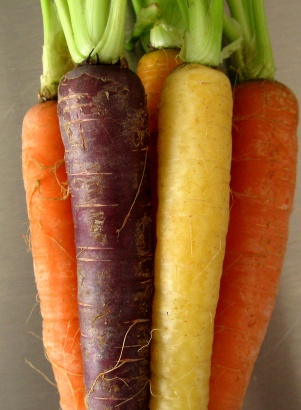
Carrots were originally PURPLE!

Carrots Used to Be Purple Before the 17th Century

Multi-colored carrots
The modern day orange carrot wasn’t cultivated until Dutch growers in the late 16th century took mutant strains of the purple carrot and gradually developed them into the sweet, plump, orange variety we have today.  Before this, pretty much all carrots were purple with mutated versions occasionally popping up including yellow and white carrots.  These were rarely cultivated and lacked the purple pigment anthocyanin.
It is thought that the modern day orange carrot was developed by crossing the mutated yellow and white rooted carrots as well as varieties of wild carrots, which are quite distinct from cultivated varieties.
Some think that the reason the orange carrot became so popular in the Netherlands was in tribute to the emblem of the House of Orange and the struggle for Dutch independence.  This could be, but it also might just be that the orange carrots that the Dutch developed were sweeter tasting and more fleshy than their purple counterparts, thus providing more food per plant and being better tasting.
Facts:
  • It is actually possible to turn your skin a shade of orange by massively over consuming orange carrots.
  • Orange carrots get their bright orange color from beta-carotene.  Beta-carotene metabolizes in the human gut from bile salts into Vitamin A.
  • The origins of the cultivated carrot is rooted in the purple carrot in the region around modern day Afghanistan.
  • When cultivation of the garden style orange carrot lapses for a few generations, the carrots revert back to their ancestral carrot types, which are very different from the current garden variety.
  • In ancient times, the root part of the carrot plant that we eat today was not typically used.  The carrot plant however was highly valued due to the medicinal value of its seeds and leaves.   For instance, Mithridates VI, King of Pontius (around 100BC) had a recipe for counteracting certain poisons with the principle ingredient being carrot seeds.  It has since been proven that this concoction actually works.
  • The Romans believed carrots and their seeds were aphrodisiacs.  As such, carrots were a common plant found in Roman gardens.  After the fall of Rome however, carrot cultivation in Europe more or less stopped until around the 10th century when Arabs reintroduced them to Europe.
  • British gunners in WWII were able to locate and shoot down German planes at night due to the invention of radar, which the Germans knew nothing about.  To cover up the invention and extreme effectiveness of radar, the British spread about an urban legend that said that they massively increased the night vision of their pilots by having them consume large amounts of carrots.  This lie not only convinced the Germans, but also had a bonus effect of causing many British people to start planting their own vegetable gardens, including planting carrots.  This urban legend has persisted even to this day.
  • The largest carrot every grown was 19 pounds; grown by John Evans in 1998 in Palmer, Alaska.
  • The Vegetable Improvement Center at Texas A&M recently developed a purple-skinned, orange fleshed carrot called the Beta Sweet.  This carrot is specialized to include substances that prevent cancer.  It also has extremely high beta-carotene content.
  • Almost one third of all carrots distributed throughout the world come from China, which is the largest distributor of carrots in the world.  Following them on gross production is Russia and then the United States.
  • Although the orange carrot was not cultivated before the 16th and 17th centuries, there is a reference in a Byzantine manuscript around 512AD which depicts an orange rooted carrot, suggesting that at least this mutant variety of carrot could be found at this time.